(a) Schematic of head-on collision in the DCI scheme. The fuels are initially compressed and accelerated by lasers. Subsequently, two plasma jets eject out from gold cone-tips and collide symmetrically at high Mach numbers, forming strong shocks in the colliding region. (b) Key features of the colliding plasma: the upstream region (blue), the shock front (orange), and the downstream region (red). Shock is maintained by the thermal pressure in the downstream, against the kinetic and degenerate pressure in the upstream. The high energy ions in the downstream region penetrate upstream beyond the shock front, leading to enhancement of the shock width [31].
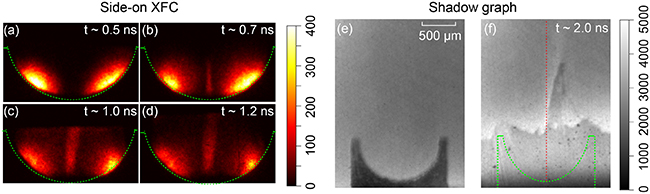
Experimental x-ray and optical images. Panels (a)–(d) depict side-on x-ray images captured from 0.5 ns to 1.2 ns. In each image, a green-dashed line delineates the initial outline of the internal wall of the Au half-cylinder. Panel (e) presents a static shadowgraphy image of an Au half-cylinder before laser irradiation, while panel (f) illustrates the shadowgraphy image displaying the distribution of Au plasma at t = 2.0~ ns.
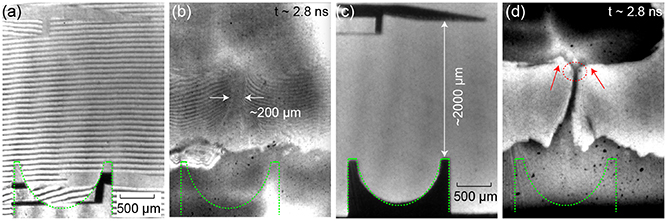
Experimental results for the interaction between Au jet and CH target. Panel (a) depicts a static Nomarski interferometer image of an Au half-cylinder and a plane CH target before laser irradiation, while panel (b) illustrates the interferometer image showing the distribution of Au and CH plasma at t = 2.8~\mathrm{ns}. Similarly, panels (c) and (d) present the corresponding experimental results for shadowgraphy.

![(a) Schematic of head-on collision in the DCI scheme. The fuels are initially compressed and accelerated by lasers. Subsequently, two plasma jets eject out from gold cone-tips and collide symmetrically at high Mach numbers, forming strong shocks in the colliding region. (b) Key features of the colliding plasma: the upstream region (blue), the shock front (orange), and the downstream region (red). Shock is maintained by the thermal pressure in the downstream, against the kinetic and degenerate pressure in the upstream. The high energy ions in the downstream region penetrate upstream beyond the shock front, leading to enhancement of the shock width [31].](https://fusionpapers-figures.s3.ap-northeast-1.amazonaws.com/nfadca45f1.jpg)