リコネクションの標準的な描像は、逆向き磁場が向かい合う電流シート(中性電流シート)である。磁場の再結合は X 型の磁気島構造(X 点)を中心に起こり、流入する磁束は X 点を通って再結合した後、両側へ高速の噴出流(アウトフロー)として流出する。X 点のごく近傍で磁力線のつながりが実際に切れる領域を拡散領域と呼び、そこでは理想 MHD の「磁力線は流体に凍りつく」という描像が破れる。再結合した磁束は下流で磁気島(プラズモイド)として切り離されることもある。
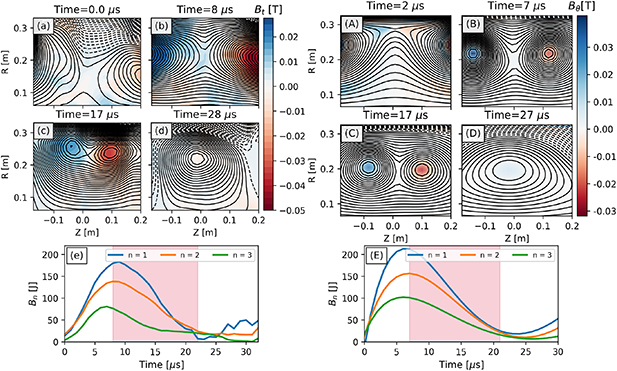
(a)–(d): The toroidal magnetic field (B_\textrm{t}) and contours of the magnetic potential Az captured by high-resolution magnetic probe arrays at flux loops formation (a), early reconnection (b), late reconnection (c), and after the termination of reconnection(d). (e): The temporal progression of low-n mode amplitudes (n = 1,2, and 3) measured by pick-up coils toroidally at (R,Z) = (0.275,0.0)\textrm{m}. (A)–(E) identical parameters as (a)–(e) obtained from a 3D Hall-MHD simulation at (R, Z) = (0.215,0.0)\textrm{m}. These values have been calculated from the normalized magnetic field.
図には、磁束ループ形成時から再結合の初期・後期、終了後に至るまでのトロイダル磁場と磁気ポテンシャルの等高線が示されており、X 点を挟んで逆向きの磁場が接近し、再結合によって単一の磁束ループが形成される様子、ならびに n = 1〜3 の低モード振幅の時間発展が実験と三次元ホール MHD シミュレーションの両方で確認できる。このように再結合の幾何学は、宇宙プラズマから実験室プラズマまで共通の構造を持つ。
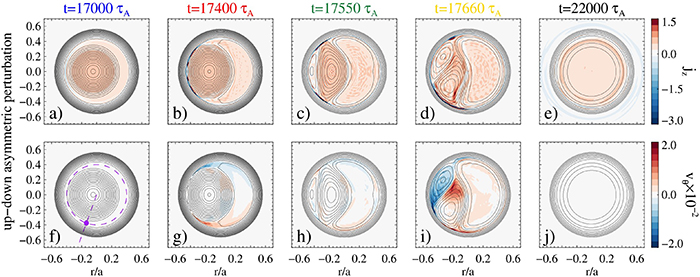
Evolution of the internal kink mode in the cylindrical tokamak (S = 10^8, M = 10^6) around the sawtooth relaxation event in figure 3. First row: axial component of the plasma current density together with the contour levels of the helical flux function with 1,1 helicity (black lines) are shown for different time snapshots. Plasmoid formation is observed at the tearing unstable current sheet on the q = 1 surface. Second row: poloidal component of the velocity field with the contour levels of the helical flux function. For the corresponding movie of the poloidal velocity component, see supplementary material S1.
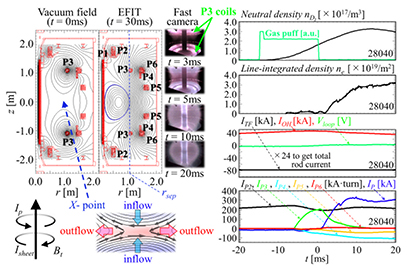
Magnetic field configuration before and after merging, and several waveforms of a solenoid-less plasma startup scenario in MAST (routinely used in ∼15 000 shots before MAST upgrade). Two plasma rings generated around P3 coils merge together around t\sim 5 ms as visualized in fast camera images and forms a spherical tokamak plasma through magnetic reconnection process.