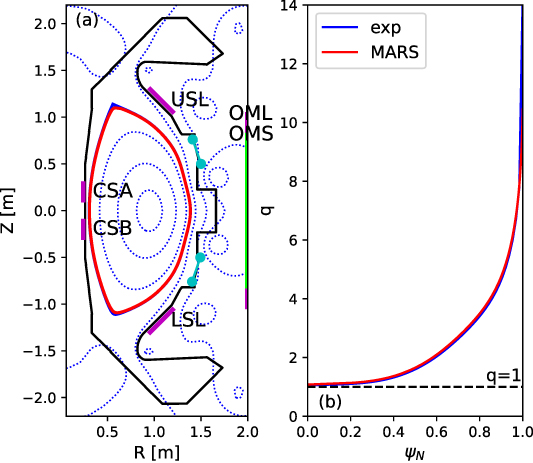
(a) Poloidal cross section of MAST-U. In black the limiter, in cyan the position of the RMP coils, in magenta and green the position of the arrays of saddle loops with their acronyms (CSA is the saddle loop array on the CenterStack Above the midplane, CSB that Below the midplane, USL and LSL the Upper and Lower Saddle Loop arrays respectively and OML and OMS the Outboard Midplane Large and Small saddle loop arrays respectively). The dotted blue lines are the experimental flux surfaces of the considered equilibrium, with the solid blue line showing the experimental last closed flux surface (LCFS). The solid red line is the LCFS used for the MARS-F simulations. In (b) there is the experimental safety factor (q) radial profile in blue and the modified q radial profile for the MARS-F simulations in red.
MASTの初期的な結果報告と装置特性の把握が中心である。H-mode、スクレイプオフ層、プラズマ制御、ELMに並んで、データ取得系や軟X線といった計測技術が論じられており、装置立ち上げ期の総合的な実験研究を示す。代表的な論文として「First results from MAST」や「Overview of recent experimental results on MAST」がある。
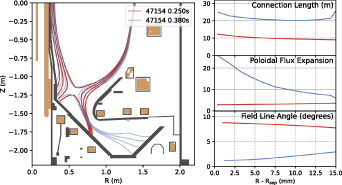
(Left) Equilibrium reconstructions in conventional (red) and Super-X (blue) divertor configurations in shot 47154 at 0.25 s and 0.38 s respectively and (right) radial profiles of parallel connection length, poloidal flux expansion and field line incidence angle.
この時代のMAST研究はELMと密接に関わり、外部・内部コイルによる共鳴磁場摂動(RMP)を用いたELM制御実験が主要な位置を占める。H-mode、ペデスタル、スクレイプオフ層などの周辺物理に加え、MASTとITERとの比較やASDEX-Upgradeとの関連が現れ、装置間の知見共有が進む。論文では「Resonant magnetic perturbation experiments on MAST using external and internal coils for ELM control」や「Modelling of plasma response to resonant magnetic perturbation fields in MAST and ITER」が代表的である。