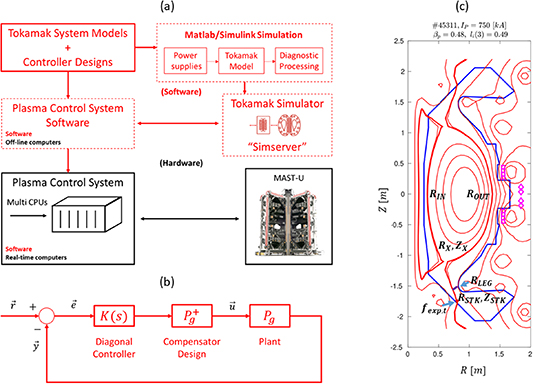
(a) MAST-U TokSys environment including the modeling environment is shown in the top boxes. MAST-U model-based closed-loop simulation environment is shown in the middle boxes. The actual MAST-U PCS/Tokamak closed-loop system is schematically shown in the bottom two boxes. (b) Simplified block diagram representation of plasma shape control algorithm for MAST-U. (c) MAST-U poloidal cross-section showing the conventional double null plasma magnetic equilibrium obtained with off-line EFIT, along with the location of the magnetic shape control variables. The magenta squares and diamonds give the position of the flux loops and magnetic probes used by LEMUR for reconstructing{ }{R_{{\text{OUT}}}}.
が磁気流体力学(MHD)平衡の基本方程式であり、ここで p は圧力、j は電流密度、B は磁場である。この釣り合いが成り立つとき、磁力線は閉じた「磁面」をなして入れ子状に積み重なり、プラズマはその入れ子の内側に保持される。磁面の最も内側の点を磁軸、最も外側でプラズマと接する面を最外閉磁面(LCFS)と呼ぶ。平衡の解が得られると、圧力や電流といった物理量を磁面を座標として表せるため、輸送解析や安定性解析に共通して使える基準座標系が得られる。この意味で平衡計算は閉じ込め研究の「地図作り」に相当する。
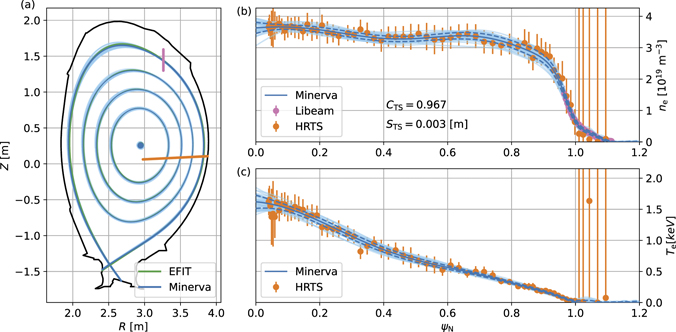
The results without the equilibrium prior for JET discharge #89709 at 8.0 s (an L-mode plasma): (a) magnetic flux surfaces ψN on the poloidal plane, (b) ne and (c) Te with respect to ψN. The magnetic axis, flux surfaces at ψN = 0.25, 0.50, 0.75 and the LCFS are depicted as blue dots, thin lines and thick lines. For comparison, we show the flux surfaces (in green) from the EFIT magnetic equilibrium reconstruction, and ne and Te from the conventional analysis for the HRTS (in orange) and the lithium beam (in pink) systems. The ne and Te positions of the HRTS and lithium beam systems are depicted as small orange and pink dots.