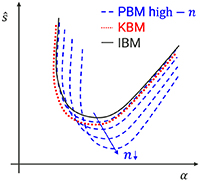
Schematic of the ballooning boundary in the \hat{s}-\alpha diagram and comparison between local ideal (IBM), kinetic (KBM), and global high-n peeling–ballooning (PBM) mode. The arrow indicates the direction of decreasing n. The peeling component of the global stability boundary is not depicted in this schematic picture.
理想MHDの枠組みでのバルーニング安定性は、正規化圧力勾配 α に対する限界を与える。α が小さい間は第一安定領域にあり、α が限界を超えると高 n バルーニングモードが不安定になる。しかし α をさらに上げると、せん断が小さい領域では再び安定化する領域が現れる。これが第二安定領域であり、十分に低い磁気せん断と整形された平衡では、α をいくら上げても安定境界が存在しなくなる。第二安定領域への到達は、高い圧力勾配を許容する可能性として古くから注目されてきた。
ただし、この見通しには重要な留保がついている。第一に、第二安定領域へのアクセスは有限 n 効果に敏感である。局所解析では安定に見えても、高 n のキンク・ピーリング成分との結合を含む大域的解析では安定領域が閉じることがある。第二に、運動論的効果である。ペデスタルのような低衝突性プラズマでは、反磁性ドリフトやランダウ共鳴などの有限ラーモア半径効果が理想MHDの閾値を下げる方向に働き、運動論的バルーニングモード(KBM)の閾値は理想バルーニングモード(IBM)のそれより低くなる。特に低アスペクト比トカマクではこの差が顕著で、理想計算が過大なペデスタル高さを予測するずれの原因として指摘されている。さらに大域的ジャイロ運動論シミュレーションでは、低せん断条件下で運動論的効果が第二安定領域へのアクセス自体を閉ざすことが示されている。このため、ペデスタル構造を予測する代表的なモデルでは、ペデスタルの幅と高さの関係を KBM の発生限界で与える「ソフトな」輸送制約と、ピーリング・バルーニング不安定による「ハードな」限界の二つの制約で記述する手法が標準となっている。
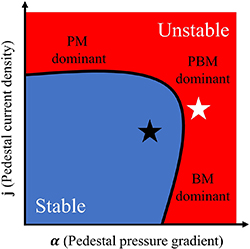
An example of j-\alpha diagram. The x-axis and y-axis correspond to the normalized pedestal pressure gradient and current density, respectively. At each side of the stability boundary, the most dominant modes are indicated, with PM, PBM, and BM representing Peeling Mode, Peeling–Ballooning Mode, and Ballooning Mode, respectively. Stars represent two equilibria with different pedestal pressure gradients and current densities.
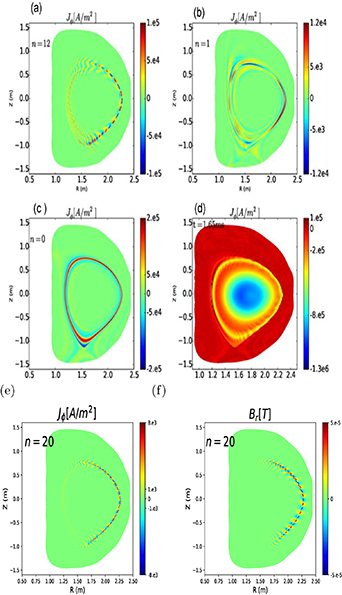
Modal decomposition of current density shown in figure 6: nonlinear mode structures of current density for (a) n = 12 ballooning mode with localized structure on the low-field side (in the bad curvature region), (b) n = 1 peeling mode with more poloidally symmetric structure, (c) nonlinearly generated axisymmetric n = 0 and (d) total current density including the equilibrium (t = 0) at t = 1.65 ms (case A-1). Modal structures during early phase of simulation with k_{||}/k_{\perp} = 1e^6/1 (e) modal current density (f) and radial magnetic field for n = 20 ballooning mode (case A-2).
非線形シミュレーションは、ELMのダイナミクスを段階的に描き出している。まず中間 n のバルーニングモードが悪曲率側に局在した構造で指数関数的に成長し(図の n = 12 の電流摂動が低磁場側に局在しているのがそれである)、次いで線形には安定な低 n ピーリング成分が非線形に成長する。その後、薄い電流シートの形成と二次的なプラズモイド不安定による高速磁気再結合を経て、フィラメントがスクレイプオフ層へ延伸しながらペデスタルが弛緩する。このように、線形段階ではバルーニング的だった擾乱が、非線形段階で再結合を介した爆発的過程へ移行することが明らかになりつつある。