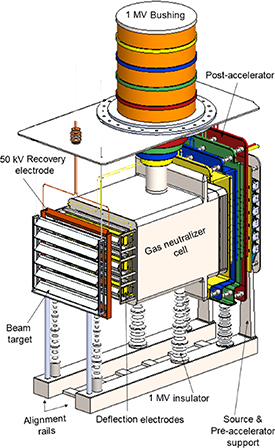
まずイオン源でプラズマを生成し、多孔の加速グリッド(電極群)で数十キロ電子ボルトからメガ電子ボルト級のイオンビームを取り出す。加速されたイオンは中性化器(ニュートラライザ)と呼ばれるガスセルを通過し、ここでガス原子との電荷交換によって中性原子に変換される。中性化しきれずに残ったイオンは偏向磁石か電場でビーム軸から分離してダンプに落とされ、中性成分だけが導管を通って閉じ込め容器へ入る。残留イオンの分離には、従来の磁石式に代えて水冷板電極で電場を作る静電残留イオン偏向装置(electrostatic residual ion dump, ERID)が採用されつつあり、ITERでも磁石式に比べて小型で、核環境下でのコイル寿命の問題を回避できることを理由にERIDが選ばれた。ビームライン全体は巨大なクライオポンプで排気され、中性化器からのガスがプラズマ側へ流れ込むのを抑えている。
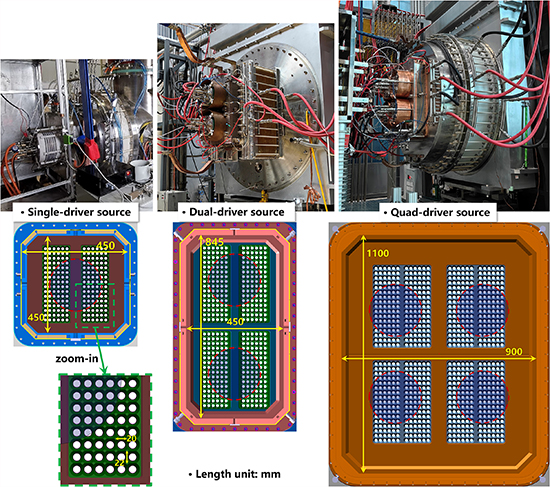
Pictures of the CRAFT negative ion sources and their aperture arrangements. From left to right: single-driver, dual-driver and quad-driver RF negative ion sources that already tested under the CRAFT project. Single-driver, dual-driver and quad-driver RF negative ion sources are equipped with 50 keV, 200 keV and 200 keV accelerators, respectively. The quad-driver one will be upgraded to 400 keV accelerator as long as the higher acceleration voltage power supply is ready.
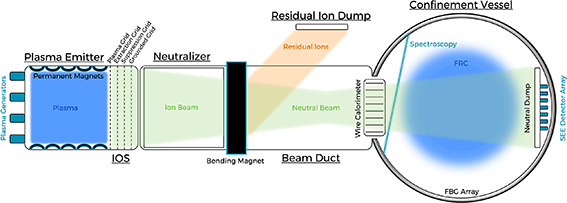
The C-2W tunable energy beam line. The plasma emitter consists of four plasma generators, a vacuum chamber, and permanent magnets along the wall. The ion optics system forms the ion beam, and contains the plasma grid, the extraction grid, the electron suppression grid, and the grounded grid. The ion beam traverses the neutralizer that contains a gas density suitable for converting most of the ions into neutrals via charge-exchange. The residual ions within the mostly neutralized beam are extracted by a bending magnet and stop on the residual ion beam dump. The neutral beam then traverses through the beam duct and into the confinement vessel (CV). Most of the beam is ionized by the FRC plasma and any residual neutral particles stop on the neutral beam dump. The beam is diagnosed in situ by a wire calorimeter, spectroscopy, and an array of secondary electron emission detectors within the neutral beam dump. First-orbit or charge-exchange losses of NBI-created fast ions can be measured by the fiber-Brag grating arrays along the wall of the CV. Lastly, the only difference between the TNB and SNB beam lines, in general, are the number of grids (four versus three) in the ion optic system. The impact parameter is r = 0 cm in the figure, but this is for pictorial simplicity (nominally r = 20 cm). This model is not to scale.